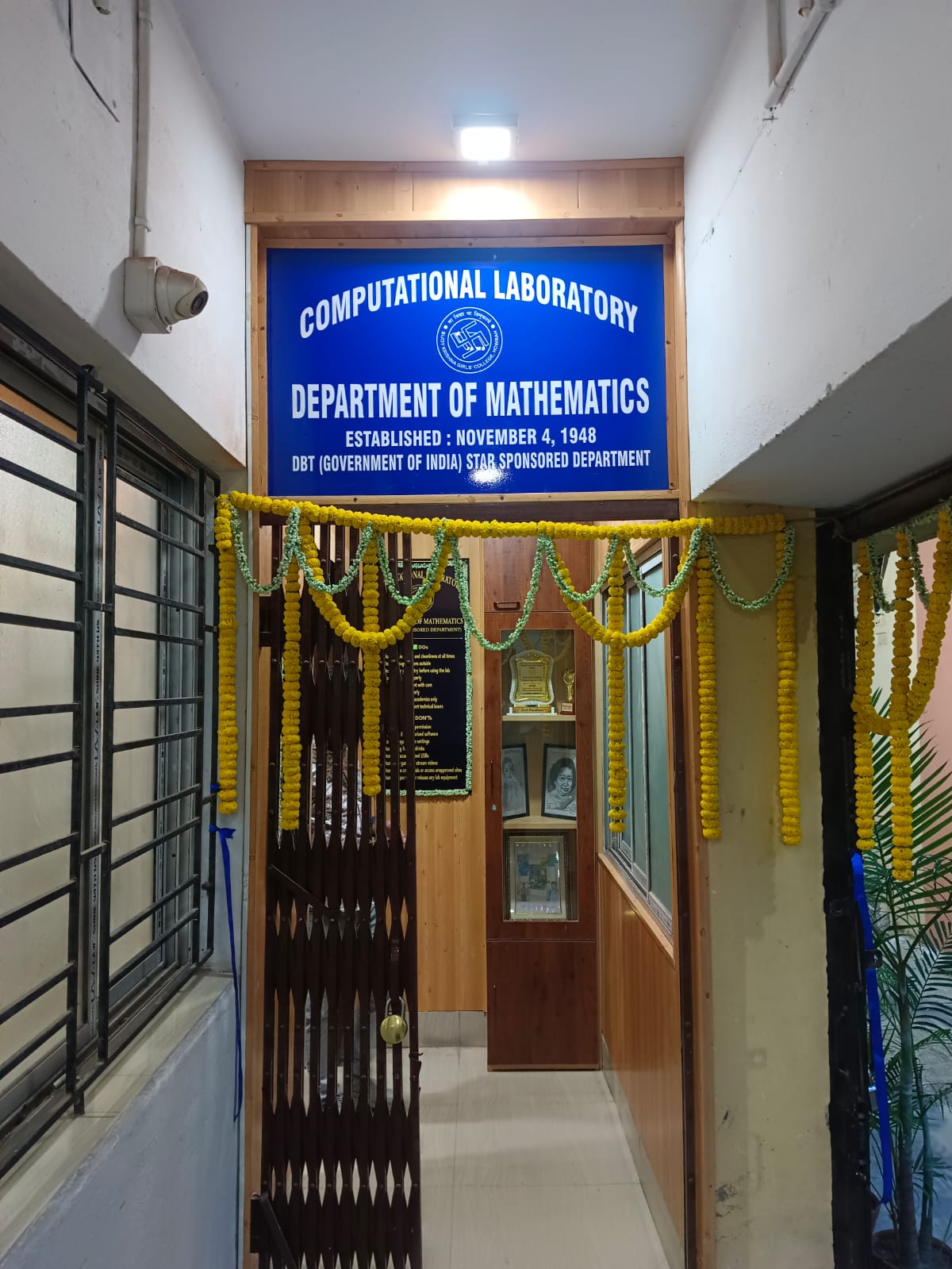
The Department of Mathematics at Bijoy Krishna Girls’ College, established on 4 November 1948, emerged in the formative years of a newly independent nation, as part of a broader institutional commitment to expanding access to rigorous higher education for women. Within this context, the department was conceived not merely as a teaching unit, but as a space for cultivating disciplined thought and intellectual clarity.
From its early role in the Intermediate Science (I.Sc.) programme to the subsequent introduction of the B.Sc. Mathematics (General) course in 1965 and the B.Sc. Mathematics (Honours) programme in 1980, the department has undergone a steady process of academic consolidation. This evolution reflects not only an expansion of curriculum, but a deepening engagement with mathematics as a domain of abstraction, structure, and logical necessity.
Within the department, mathematics has consistently been approached as a language of precise reasoning rather than a collection of techniques. The pedagogical tradition that developed here places emphasis on conceptual understanding, methodological rigour, and the disciplined development of ideas. In this environment, learning is not limited to acquisition, but extends to the reconstruction of knowledge through thought.
The history of the department is best understood as a continuity of intellectual transmission, sustained through successive generations of faculty. Each has contributed to shaping and preserving a shared academic ethos grounded in clarity, patience, and exactness.
The following lineage reflects this continuity:
- 1948 – Baby Seal
- 1961 – Kshama Mukherjee
- 1965 – Tarun Ranjan Majumder
- 1966 – Nirmal Kumar Basu
- 1966 – Tapan Kumar Dey
- 1975 – Dr. Bibhas Chandra Samanta
- 1982 – Dr. Subha Chandra
- 1983 – Dr. Swapna Das Gupta
- 2000 – Ranen Bhattacharya
- 2005 – Dr. Nabin Kumar Jana
- 2015 – Dr. Rupak Bhattacharyya
- 2015 – Dr. Pratap Mondal
- 2017 – Dr. Samiran Banerjee
In its present form, as a DBT STAR College Scheme–supported department, the Department of Mathematics stands at the intersection of tradition and contemporary academic practice. While incorporating modern curricular frameworks such as the CCF 2022, computational methods, and interdisciplinary perspectives, it continues to uphold its foundational commitment to mathematics as a rigorous intellectual discipline.
New layer...